

Roulette
A wheel-and-ball game of pure chance with a fixed house edge of 2.70% on the single-zero wheel.
- House edge 2.7% to 5.26%
- Luck only
- Many players can bet on the same spin at one table
- Typically about 30 to 60 seconds per spin at a live table; online random-number games can be faster
Information only. 18+. The house edge means players lose on average over time.
Overview
Roulette is a casino game in which a ball is spun around a numbered wheel and players bet on where it will stop. On the standard European wheel every bet has the same 2.70% house edge, and the American double-zero wheel raises it to 5.26% on most bets. The outcome of each spin is random.
Roulette (French for 'little wheel') is a casino game of chance. A croupier spins a wheel in one direction and spins a small ball in the opposite direction around a tilted track; the ball eventually slows down, drops into one of the numbered pockets, and every bet that covers that pocket is paid. Players can back a single number, small groups of numbers, or large groups such as red or black, odd or even, and low or high.
The game as it is played today was developed in France in the 18th century. An early description of a wheel with a zero and a double zero appears in a French novel published in 1801 that describes a wheel in the Palais Royal in Paris in 1796. In 1843 the brothers Francois and Louis Blanc introduced the single-zero wheel at the spa casino in Bad Homburg, Germany, and it later became the standard in Monte Carlo and across most of Europe, while the double-zero wheel stayed dominant in the United States and some other regions.
Roulette is now played at physical tables, in online games driven by a random number generator, and in live-dealer games where a real wheel is filmed and streamed so that players can bet from a screen. The rules, the layout and the payout table are the same in every version: what changes between versions is the number of zero pockets on the wheel, which decides the house edge.
- Origin
- France, 18th century (current form recorded in Paris in 1796)
- Name
- French for 'little wheel'
- Wheel (European)
- 37 pockets: 0 to 36, one green zero, 18 red and 18 black
- Wheel (American)
- 38 pockets: 0, 00 and 1 to 36
- Highest standard payout
- 35 to 1 on a single number
- House edge
- 2.70% (single zero) or 5.26% (double zero) on most bets
- Bet types
- Inside bets (numbers) and outside bets (colours, parity, ranges)
- Where played
- Casino tables, online random-number games and live-dealer streams
How to play Roulette
- 1Look at the wheel type. A single-zero wheel has 37 pockets (0 to 36); a double-zero wheel has 38 pockets (0, 00 and 1 to 36). This decides the house edge.
- 2Understand the layout. The betting layout shows the numbers 1 to 36 in rows and columns, with zero (and double zero) at the top, and areas around the edge for outside bets.
- 3Choose the kind of bet. Inside bets cover a number or a small group of neighbouring numbers; outside bets cover larger groups such as red or black, odd or even, 1 to 18 or 19 to 36, a dozen or a column.
- 4Place chips on the layout while betting is open. Where a chip sits decides which numbers it covers, for example on a number for a straight-up bet or on the line between two numbers for a split.
- 5The croupier spins the wheel and launches the ball in the opposite direction. Bets can usually be placed until the croupier calls 'no more bets' (in French, 'rien ne va plus').
- 6The ball lands in a pocket. The croupier places a marker on the winning number on the layout, and no bets may be touched until payouts are finished.
- 7Losing bets are cleared. Winning bets are paid at the odds shown for that bet type, and the original stake on a winning bet stays on the table to be collected or left in play.
- 8A new round begins. Each spin is independent: the wheel has no memory of earlier results.
Rules
- On a European wheel there are 37 pockets, so the chance of any single number is 1 in 37 (2.70%); on an American wheel it is 1 in 38 (2.63%).
- Each pocket has the same chance of receiving the ball, and each spin is independent of all earlier spins.
- Inside bets are placed on single numbers or small groups of adjacent numbers: straight up, split, street, corner, six line, and on some layouts the first four or trio bets.
- Outside bets cover large groups: red or black, odd or even, 1 to 18 or 19 to 36, the three dozens and the three columns.
- A zero pocket (or 00) is neither red nor black, neither odd nor even, and neither low nor high, so even-money outside bets lose when it comes up unless a special zero rule applies.
- Payouts are fixed by bet type and are the same on both wheel types: 35 to 1 straight up, 17 to 1 split, 11 to 1 street, 8 to 1 corner, 5 to 1 six line, 2 to 1 dozen or column, 1 to 1 for even-money bets.
- Tables set minimum and maximum bets, and these limits commonly apply separately to a player's inside bets and outside bets on each spin.
- Under the La Partage rule (common on French-style wheels), an even-money bet loses only half the stake when the ball lands on zero.
- Under the En Prison rule, an even-money bet is held 'in prison' after a zero and is returned if the next spin would be a win for that bet.
- No bets can be placed, moved or removed once the croupier has closed betting for the spin.
- In online games a certified random number generator selects the result; in live-dealer games a real wheel is used and the result is read by the system and confirmed by the dealer.
Bets, payouts & house edge
| Bet | Pays | House edge | Notes |
|---|---|---|---|
| Straight up (one number) | 35 to 1 | 2.70% | Single-zero wheel. Chance of winning: 1 in 37. |
| Split (two adjacent numbers) | 17 to 1 | 2.70% | Chance of winning: 2 in 37. |
| Street (three numbers in a row) | 11 to 1 | 2.70% | Chance of winning: 3 in 37. |
| Corner (four numbers) | 8 to 1 | 2.70% | Chance of winning: 4 in 37. |
| First four (0-1-2-3, European layout) | 8 to 1 | 2.70% | Same edge as every other bet on a single-zero wheel. |
| Six line (two streets, six numbers) | 5 to 1 | 2.70% | Chance of winning: 6 in 37. |
| Dozen or column (12 numbers) | 2 to 1 | 2.70% | Chance of winning: 12 in 37. |
| Red / black, odd / even, 1-18 / 19-36 | 1 to 1 | 2.70% | Chance of winning: 18 in 37 (48.65%). Loses on zero. |
| Even-money bet with La Partage (single zero) | 1 to 1, half the stake back on zero | 1.35% | Only where the casino offers La Partage. |
| Straight up on an American double-zero wheel | 35 to 1 | 5.26% | Chance of winning: 1 in 38. The same 5.26% applies to every bet except the top line. |
| Even-money bet on an American double-zero wheel | 1 to 1 | 5.26% | Chance of winning: 18 in 38 (47.37%). Loses on 0 and 00. |
| Top line on an American wheel (0, 00, 1, 2, 3) | 6 to 1 | 7.89% | The only bet on the American wheel with a different edge. |
Payouts, commissions and side bets differ between providers and casinos. Always read the rules shown at the table or in the game before anything else.
How these numbers are worked out
Edges are computed as 1 minus the expected return per unit staked, using exact fractions. Assumptions: a fair wheel in which every pocket is equally likely (37 pockets for European, 38 for American); payouts as listed, with the stake kept on a win. Example: a straight-up bet on a single-zero wheel wins 35 units with probability 1/37 and loses 1 unit with probability 36/37, so the expected result is (35 - 36) / 37 = -1/37 = -2.70%. The same -1/37 applies to every single-zero bet because payouts are set to 36 divided by the number of pockets covered, minus one. On a double-zero wheel the expected result is -2/38 = -5.26%, except the top line (5 numbers paying 6 to 1), which is -3/38 = -7.89%. With La Partage on a single-zero wheel an even-money bet loses half the stake with probability 1/37, so the expected result is -0.5/37 = -1/74 = -1.35%.
Tips for playing sensibly
Check the wheel before anything else: a single-zero wheel has half the house edge of a double-zero wheel on the same bets.
Treat money spent as the cost of entertainment, not as an investment. Because of the house edge, the expected result over time is a loss.
Set a time limit and a spending limit before you start, and stop when you reach either one.
Do not chase losses. Spending more to recover money already lost only increases the expected loss.
No betting system, pattern tracking or 'hot and cold' number list changes the odds, because each spin is independent.
If La Partage or En Prison is offered on a single-zero wheel, even-money bets have a lower house edge (1.35%), but they are still negative in expectation.
Read the table limits and the payout card before betting, and know that bets are fixed and cannot be changed after the croupier closes betting.
Gambling is for adults only (18+, or the legal age where you live). If it stops being fun, take a break and consider contacting a local support service.
Common myths
Myth After a long run of reds, black is 'due'.
Truth This is the gambler's fallacy. Each spin is independent, and the chance of black stays the same (18 in 37 on a single-zero wheel) no matter what happened before.
Myth A betting system such as doubling after each loss guarantees a profit.
Truth No system can change the expected return of a bet. Doubling systems risk very large losses and run into table limits, and every individual bet still carries the same house edge.
Myth Some numbers or wheel sectors come up more often.
Truth On a fair wheel all pockets are equally likely. Observed streaks are normal in random sequences and do not predict future spins.
Myth Betting on both red and black balances out the house edge.
Truth Covering both colours still loses the full stake whenever zero comes up, so the combined expected result is still a loss.
Variants
European roulette
The standard version covered here: a wheel with 37 pockets (0 to 36), single zero, 2.70% house edge on all bets, and the most common wheel in Europe and online.
American roulette
Uses a wheel with 38 pockets (0, 00 and 1 to 36). Payouts are unchanged, so the house edge rises to 5.26% on most bets and to 7.89% on the top-line bet. It is the standard in the United States and some other regions.
French roulette
Uses the single-zero wheel with French bet names and a different table layout. It is often played with La Partage or En Prison rules that lower the house edge on even-money bets to about 1.35%.
Triple-zero roulette
Some wheels add a third zero (000). With 39 pockets, the house edge on a straight-up bet rises to 7.69%.
Glossary
- Straight up
- A bet on one single number, paying 35 to 1.
- Inside bet
- A bet on a single number or a small group of adjacent numbers on the layout.
- Outside bet
- A bet on a larger group of numbers, such as a colour, odd or even, a dozen or a column.
- Croupier
- The casino employee who spins the wheel, announces the result and pays the winning bets.
- House edge
- The average share of each stake that the casino keeps over the long run; for roulette it is a fixed percentage set by the zero pockets.
- La Partage
- A rule under which an even-money bet loses only half the stake when the ball lands on zero.
- En Prison
- A rule under which an even-money bet is held for one more spin after a zero and is returned if the next spin would be a win for it.
- Dozen
- A bet on one third of the numbers: 1 to 12, 13 to 24 or 25 to 36, paying 2 to 1.
- Column
- A bet on the 12 numbers in one vertical line of the layout, paying 2 to 1.
- Dolly
- The marker the croupier places on the winning number on the layout while bets are settled.
- Top line
- A bet on 0, 00, 1, 2 and 3 on an American layout, paying 6 to 1.
Roulette FAQ
What is the house edge in roulette?
It is 2.70% on a single-zero wheel and 5.26% on a double-zero wheel for almost every bet. This means that, on average, the casino keeps 2.70 or 5.26 units of every 100 units staked over a long run of spins.
Is European or American roulette better for the player?
The European single-zero wheel has the lower house edge (2.70% against 5.26%), so it is the more favourable version for the player. The payouts per bet are identical, but the extra 00 pocket on the American wheel makes every bet less likely to win.
Can a betting system beat roulette?
No. Systems such as doubling the stake after a loss only change how a stake is spread over time, not the odds of a single spin. Because every bet has a negative expected return, no pattern of bets can turn it positive, and a system can lead to larger losses.
Are some numbers luckier than others?
On a fair wheel every pocket has the same chance on every spin. Past results do not influence future spins, so 'hot' and 'cold' numbers are a human impression, not a feature of the wheel.
What is La Partage?
La Partage is a rule offered by some casinos on single-zero wheels: if the ball lands on zero, an even-money bet loses only half the stake. It cuts the house edge on those bets from 2.70% to 1.35%.
Is online roulette different from live roulette?
The rules and payouts are the same. In an online random-number game, a certified generator picks the number; in a live-dealer game a real wheel is spun and streamed. Both are random, but the wheel type (single or double zero) still decides the house edge.
Why does the casino always win in the long run?
Payouts are set as if the wheel had 36 numbers, but the wheel has 37 or 38 pockets. That small gap is the house edge, and over many spins it works out to a steady average loss for players.
What is the minimum age to play?
Gambling is for adults only. The legal age is 18 in many places and higher in others, so check the rules where you live.
Related reading
The gambler's fallacy and the myth of hot streaks
Why a number is never "due", why red does not become likelier after a run of black, and what roulette really tells us about random streaks.
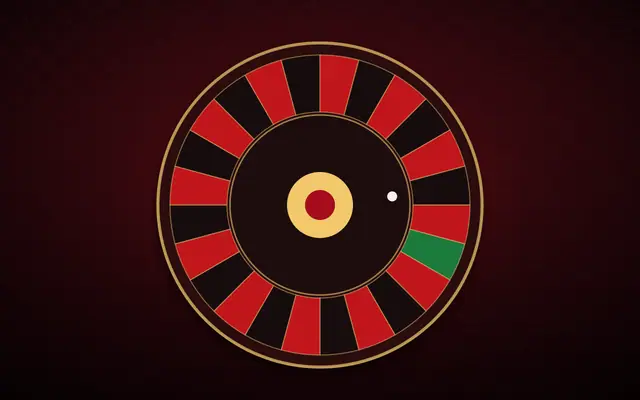
European, American and French roulette compared
How the extra zero changes the house edge from 2.70% to 5.26%, what La Partage does, and why payouts stay the same on every wheel.
Keep learning
More games explained
 Table games
Baccarat
A two-hand comparing card game where every move is fixed by rules; the Banker bet carries a 1.06% house edge.
Rules & odds Instant games
Crash
How crash games work: a rising multiplier, a hidden crash point and a built-in house edge
Rules & odds Card games
Andar Bahar
An Indian one-deck card game: guess which side gets the card matching the joker first; edge about 2% to 3%.
Rules & odds Lottery
Lottery
How number lotteries work: matrix formats, draws, jackpots, rollovers and the odds behind each prize.
Rules & odds